DLSS vs FSR vs XeSS Upscaling Compared for Builders
Your GPU choice locks you into one upscaler ecosystem with no switching later.

Summary
Your GPU choice locks you into one upscaler ecosystem with no switching later.
A builder who treats upscaling as a post-purchase toggle has already made a mistake. The GPU placed in the build determines which upscaling ecosystem that build will access, and that access is absolute: no workaround exists to run DLSS on a non-RTX card, no patch will bring FSR 4's machine-learning path to an RDNA 3 card, and XeSS reaches its best quality only on Intel Arc silicon. This is a hardware commitment made at the moment of purchase. The reason this distinction matters more now than it did five years ago is that modern games ship with performance figures measured using upscaling enabled. A builder who ignores upscaling support is effectively ignoring a core specification of their GPU, the same way they would ignore VRAM capacity or memory bandwidth.
Three separate ecosystems exist, each developed by one of the three GPU vendors, and their lock-in mechanics differ meaningfully. DLSS is proprietary and RTX-exclusive, with no path to other hardware. FSR is open, runs on all three vendors, but gates its machine-learning quality to RDNA 4. XeSS runs cross-vendor, but its best path requires Intel Arc XMX cores, with a DP4a fallback path elsewhere that delivers visibly lower fidelity. Understanding these boundaries before selecting a GPU prevents the disappointment of discovering, after the build is assembled, that the upscaler a builder wanted was never available on the card they bought.
What upscaling and frame generation actually do, and why the difference matters before you buy
Upscaling and frame generation are distinct mechanisms with different effects on gameplay, and conflating them leads builders to overvalue frame counts that don't translate into responsiveness. The distinction is the conceptual foundation on which every GPU decision in this space rests. Upscaling works by having the GPU render at a lower internal resolution, typically 50 to 77 percent of the target resolution depending on quality mode, then using a trained model to reconstruct the full-resolution frame. It uses motion vectors, depth buffers, and prior frames to fill in what is missing. This is why quality mode selection matters: a Performance mode asks the model to invent more of the image, while Quality mode preserves a larger share of the real rendered information.
Frame generation operates on a categorically different principle. If a game doubles its frame count through frame generation, your mouse and keyboard still respond at the base render rate, so input feels like the base frame rate. The practical rule follows directly: use upscaling to fix a sluggish game, and use frame generation only when the base rate is already comfortable and additional visual smoothness on a high-refresh monitor is the goal.
Competitive players understand this distinction instinctively. They keep upscaling active with latency tools running, since upscaling's improvement to responsiveness is genuine. Build Core surfaces this distinction in its configurator by tying performance estimates to specific GPU and game combinations, so a builder can forecast how a card will actually feel in their target titles before hardware arrives.
DLSS 4: what NVIDIA's ecosystem delivers and which RTX hardware unlocks it
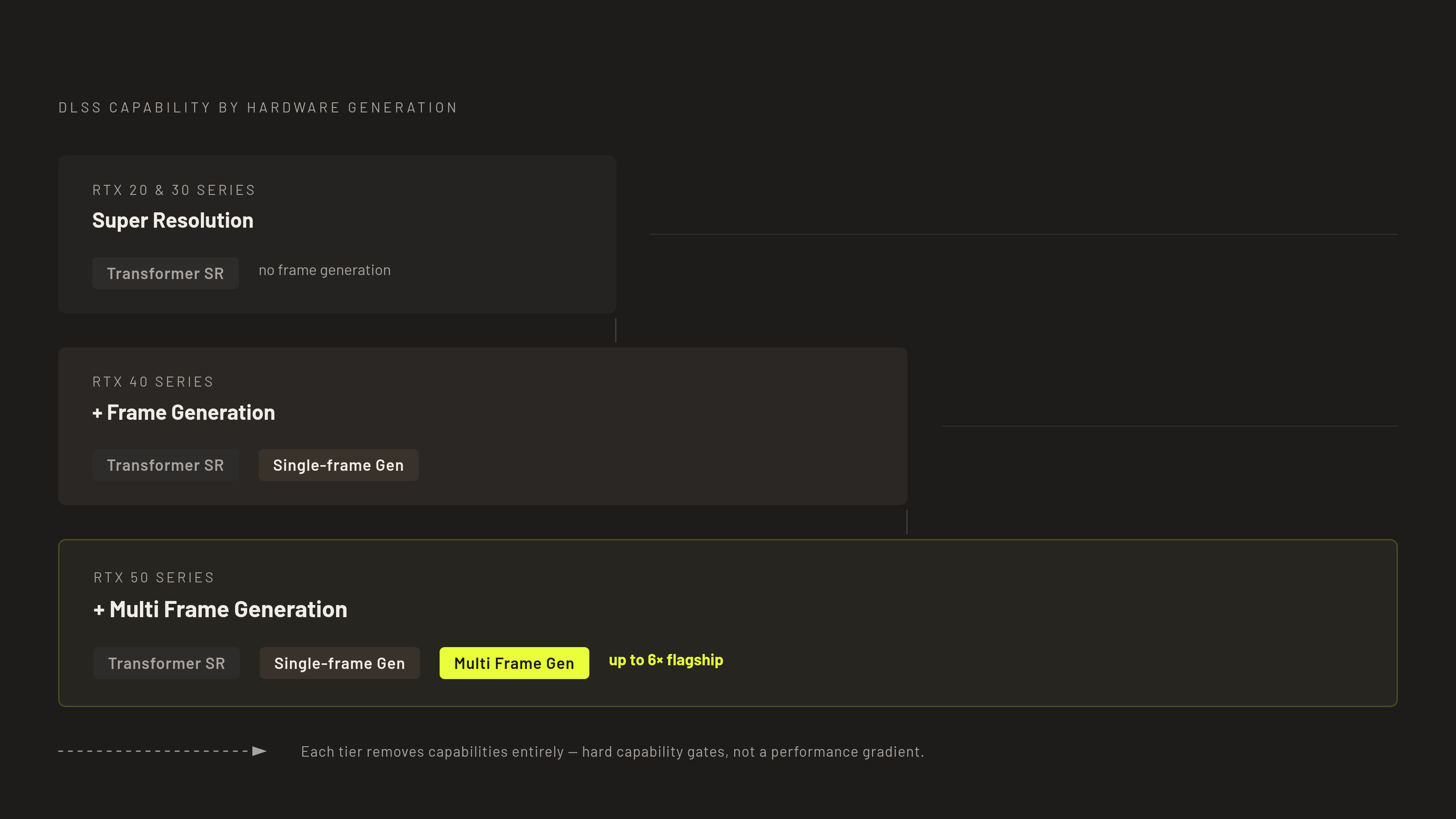
DLSS 4 is the image-quality leader among the three upscalers, but its features are tiered across RTX generations in ways that make GPU selection within the NVIDIA lineup a meaningful decision rather than a simple brand choice. Two cards wearing the same badge can deliver meaningfully different upscaling capabilities, and that divergence is not buried in a spec sheet so much as it is the spec. The most significant technical change in DLSS 4 is the shift from the convolutional neural network of earlier versions to a transformer model, the same architectural family that drives modern language models. The practical result is better temporal stability on thin geometry like fences and power lines, less ghosting on fast-moving objects, and sharper fine detail at distance. The transformer Super Resolution model runs on every RTX generation from the 20 series onward, so owners of older RTX cards still get the improved image quality, but they cannot access the frame generation features.
The feature tiers are where the hardware gate becomes concrete. RTX 20 and 30 series cards get transformer Super Resolution only, with no frame generation. RTX 40 series cards add single-frame Frame Generation. RTX 50 series cards unlock Multi Frame Generation, the most capable frame multiplier currently available at up to 6x on flagship hardware. DLSS 4.5, rolling out through 2026, adds a second-generation transformer model for Super Resolution using substantially more compute than the original DLSS 4 transformer, and this upgrade is available across RTX GPUs in a growing library of supported games and apps.
If you are planning a ray-tracing build, also know that DLSS 4 includes Ray Reconstruction for ray-traced scenes and DLAA, AI anti-aliasing at native resolution. No AMD card, no Intel card, and no non-RTX NVIDIA card can access it, and even within RTX hardware, not all features are available across all generations. This tiering means a builder weighing which GPU tier makes sense for their goals and monitor setup needs that information at planning time, not after the card is installed.
FSR 4: AMD's open upscaler, what the RDNA 4 gate means, and who FSR still serves on older hardware
FSR's most important characteristic is not its image quality ceiling but its universal reach. It is the only upscaler of the three that runs on hardware from all three GPU vendors, which makes it the default fallback for any game that wants to cover its entire player base rather than a subset. That structural position has kept FSR relevant even as DLSS has extended its quality lead.
FSR 4 represents a genuine break from what came before. It is AMD's first upscaler built around a true machine-learning model, running on the dedicated AI accelerators inside RDNA 4, the Radeon RX 9000 series, rather than the hand-tuned spatial and temporal algorithms of FSR 1 through 3. Owners of RDNA 3 and older cards are limited to FSR 3.1, which remains functional but cannot match FSR 4 image quality.
The FSR Redstone suite bundles FSR Upscaling with FSR Frame Generation, FSR Ray Regeneration, and FSR Radiance Caching. On games that support AMD Anti-Lag 2 natively, FSR Frame Generation's latency penalty is competitive with DLSS Frame Generation plus Reflex. A secondary concern flagged by reviewers is that FSR Redstone frame-pacing inconsistencies have been reported on RDNA 4, where raw fps numbers look strong but perceived smoothness is reduced. This matters for builders who prioritize feel over benchmark results.
FSR's cross-platform reach is the strongest structural argument for its continued developer relevance. The full ML-powered feature set is currently limited to RDNA 4 hardware, with PlayStation FSR Redstone Frame Generation confirmed no earlier than 2027 and handheld and RDNA 2-3 support still on AMD's future roadmap. But a game that ships with FSR support covers consoles and handhelds at once, so developers keep adopting it even when AMD and NVIDIA shift market share. What matters is not whether every Redstone feature reaches every platform, but whether FSR as a technology stays embedded in developer pipelines.
The library picture is mixed. Among 2025-release games, FSR 4 support reaches a majority of titles at matched quality thresholds, though DLSS 4 support at equivalent thresholds is higher. A meaningful back-catalog liability exists: a significant share of older titles offer no AMD upscaling path while supporting DLSS, which is relevant for builders who play across a wide game library rather than only recent releases.
XeSS 2: Intel's cross-vendor upscaler and the value case it makes on Arc hardware
XeSS is the only upscaler of the three whose image quality explicitly depends on which vendor's hardware it runs on, making the Arc versus non-Arc distinction a genuine buying consideration rather than a minor footnote. With this dual-path structure, the same game at the same XeSS setting produces visibly different results on different cards. The XMX path on Intel Arc uses Arc's dedicated matrix engines and delivers noticeably better quality than legacy FSR on Arc hardware, positioned between FSR 4 and DLSS 4 at the margins. The DP4a fallback path, used on AMD and NVIDIA GPUs, is noticeably behind. XeSS 3 adds Multi Frame Generation, available across nearly all Arc GPUs and even Core Ultra integrated graphics, a notable reach that extends frame generation beyond the discrete GPU category entirely.
The frame generation latency caveat deserves attention because it is specific to XeSS. Intel does not yet have a latency-mitigation layer as broadly adopted as NVIDIA Reflex or AMD Anti-Lag 2, meaning the full buffering penalty from XeSS frame generation hits without mitigation in many titles. For builders planning competitive or latency-sensitive use, this is a real consideration rather than an abstract spec-sheet comparison.
The Arc B580 makes a coherent value argument at the budget end of the market. The feature set exists and works, but it has not yet been broadly exercised across the game catalog. The practical summary is straightforward: XeSS on Arc is the value path, and XeSS on a non-Arc GPU is a fallback rather than a first choice.
How each upscaler performs in practice: image quality, frame generation, and where the gaps are real
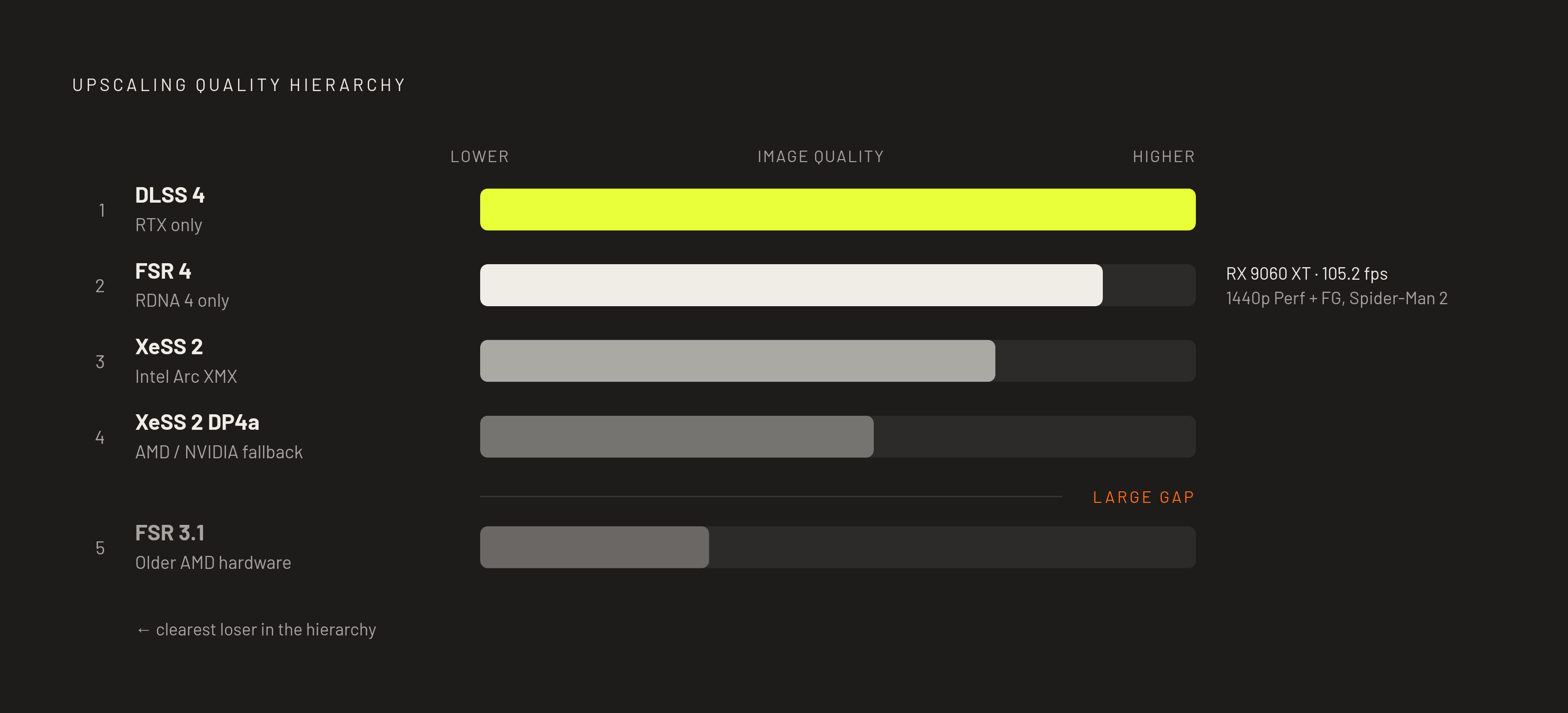
The image quality hierarchy among the three technologies is real, but the resolution and scene type a builder targets determines whether the gap is visible enough to drive a buying decision. DLSS 4 leads, with its transformer model's advantage clearest on thin geometry like fences, foliage, and power lines, on fast-moving objects, and on high-contrast edges during camera pans. At 4K Quality mode, you are hard pressed to tell DLSS 4 from native rendering.
FSR 4 on RDNA 4 hardware is close behind. The jump from FSR 3.1 to FSR 4 is large, and FSR 4 now trails DLSS 4 only in the hardest scenes involving fine detail and particle-heavy effects. XeSS 2 on Arc hardware sits between the two, while the DP4a path on non-Arc hardware is noticeably behind. FSR 3.1, the path available to older AMD hardware, sits below the other three.
Where the quality gap matters most aligns with resolution. At 1080p, still the dominant gaming resolution, the quality delta between DLSS and FSR is smaller than marketing materials suggest. So if you target 1080p, give GPU price and game library support more weight than upscaler quality rankings.
Frame generation comparison shows a similar tiering. FSR Redstone Frame Generation is broadly available on RDNA 4 and competitive in raw output, with latency comparable to DLSS Frame Generation plus Reflex on supported titles, though the frame-pacing inconsistencies noted by reviewers remain a consideration. A concrete data point grounds the mid-range comparison: on an RX 9060 XT versus RTX 5060 Ti comparison at 1440p, FSR 4 Performance mode plus frame generation achieved 105.2 fps in Marvel's Spider-Man 2, a genuinely competitive result at mid-range price points.
Game library coverage: why the number of supported titles shapes a GPU purchase more than benchmark scores
Image quality rankings between upscalers are nearly irrelevant in a title that only supports one of them, and library gaps are large enough to affect the real-world experience of a significant portion of builders. The number of supported titles is a specification in the same sense that VRAM capacity is, and it deserves to be checked the same way. DLSS and RTX support spans 769 games and applications, a count that outpaces the equivalent totals for FSR 4 and XeSS 2 at matched quality thresholds by a wide margin. Among 2025-release titles restricted to quality-capable versions, defined as DLSS 3 or newer, XeSS 1.3 or newer, or FSR 4, DLSS appears in the vast majority, FSR 4 in a meaningful but smaller share, and XeSS in a smaller share still. XeSS 2 with frame generation sat at roughly 44 titles as of mid-2026, a fraction of DLSS 4's Multi Frame Generation library and behind FSR Redstone's equivalent count.
The back-catalog picture cuts against AMD in a specific way. Yet FSR has a structural counterweight. The practical implication for builders is direct: anyone with a specific game list should verify upscaler support for those titles before committing to a GPU ecosystem.
What the Steam Hardware Survey data tells builders about which upscalers matter for the existing install base
Community hardware data reframes the upscaler conversation in a way that pure quality rankings cannot. The Steam Hardware Survey from July 2026 shows NVIDIA holding roughly three-quarters of the surveyed GPU pool, with AMD and Intel together at roughly a quarter. A studio that ships without FSR excludes a meaningful share of its PC audience, and that is the strongest argument for FSR's continued developer relevance.
The RTX 5070 became the most-used GPU on the platform in September 2026, at 5.86 percent of the surveyed pool, up substantially from the prior month. This indicates that DLSS-capable hardware is actively proliferating, but the majority of the installed base is still on older hardware where Multi Frame Generation is unavailable. The DLSS ecosystem is growing, and its full feature set remains concentrated in a minority of active cards.
Two other trends matter for upscaler decisions. If you are weighing the Arc B580's 12GB and the RDNA 4 cards' 16GB against 8GB RTX mid-range entries, this context helps. Second, resolution distribution: 1080p remains the dominant gaming resolution at roughly half of all Steam systems surveyed, 1440p has climbed to roughly a fifth, and 4K remains a small share. Since the quality gap between DLSS 4 and FSR 4 is most visible at 4K, builders targeting 1440p or 4K have more reason to weight upscaler quality in their GPU decision than those building primarily for 1080p, where the practical difference is smaller.
Matching upscaler to build tier: how to factor upscaling support into a GPU decision at each budget
The right upscaler for a given builder is not determined by which technology scores highest in reviews. It is determined by which GPU fits the build budget and resolution target, with upscaling support as a confirming factor rather than the primary selection criterion. Each budget tier carries a distinct upscaling outcome, and the tradeoffs within each tier are legible before purchase.
At the budget tier, roughly $750 to $900, the Intel Arc B580 12GB makes its case through XeSS upscaling on the XMX path plus XeSS 2 Frame Generation on a growing game list. The 12GB of GDDR6 on a 192-bit bus gives it more texture headroom than any 8GB card at this price point. The tradeoff is that XeSS 2 frame generation's game library is smaller than DLSS or FSR equivalents, and XeLL latency mitigation is not yet widely adopted, so frame generation carries a higher effective latency cost in unsupported titles.
The mid-range tier, roughly $1,600 to $1,700, is where the NVIDIA RTX 5060 8GB sits. It delivers DLSS 4 Super Resolution on the transformer model, single-frame Frame Generation, and Multi Frame Generation, with the widest game library of the three upscalers and NVIDIA Reflex available for latency mitigation. The 8GB VRAM is the key tradeoff at this tier against RDNA 4 alternatives offering 16GB, and it is directly relevant for builders targeting texture-heavy titles at 1440p. This is a case where upscaling capability and VRAM constraints pull in opposite directions, and the resolution target should decide which matters more.
The 1440p-capable tier, roughly $1,900 to $2,050, points to the AMD RX 9060 XT 16GB or RX 9070 XT. These cards deliver full ML-accelerated FSR Upscaling 4.1 on RDNA 4 matrix units, with quality at this tier very close to DLSS 4 at matched presets. The 16GB of GDDR6 is the largest VRAM buffer at this price band, relevant as 16GB overtakes 8GB as the most common Steam GPU configuration. The tradeoffs are the frame-pacing inconsistencies with FSR Redstone flagged by reviewers and the higher likelihood of back-catalog titles lacking FSR support compared to DLSS.
Build Core is the practical tool for this decision. Its 3D configurator lets you visualize the full build at each tier before purchasing, its compatibility checking surfaces VRAM and platform conflicts in real time, and its multi-retailer price comparison keeps the total build cost honest across GPU options. The upscaler decision and the budget decision happen together in one planning session rather than across separate research steps, and for a choice this deeply tied to hardware selection, that integration is the point.
The one remaining open question: whether FSR's cross-platform reach or DLSS's library lead matters more long-term
The prevailing view that DLSS is the clear overall leader is well-supported, but the strongest credible objection to it is FSR's structural advantage as a cross-platform technology. This is a genuine disagreement that current data cannot resolve, and you should understand both positions before treating either as settled. The case for DLSS holding its position rests on the library lead, which is large and growing, and on DLSS 4.5's second-generation transformer model widening the quality ceiling further. FSR's console and handheld presence means developers targeting PS5, Xbox Series X/S, Steam Deck, and handheld gaming devices already have FSR in their pipeline, making PC FSR support a low-marginal-cost addition. And FSR is mostly open-source, which lowers integration friction and creates a developer ecosystem independent of AMD's market share. XeSS's long-term position depends heavily on Intel's Arc market share and the growth of the XeSS 2 game library, and both are uncertain at the current scale. A platform bet is still a bet, and the honest move is to acknowledge that the outcome years from now is unknowable, then build for what is known today.