Ray Tracing Performance Cost by GPU Tier
Full ray tracing costs vary wildly by GPU tier and setting, forcing most gamers to choose upscaling.

Summary
Full ray tracing costs vary wildly by GPU tier and setting, forcing most gamers to choose upscaling.
Ray tracing costs more than any other graphics setting because it simulates light, and that simulation scales with scene complexity as well as resolution. Traditional rasterization fakes lighting with pre-baked textures, shadow maps, and screen-space tricks, all shortcuts the GPU industry has spent decades optimizing into near-zero cost. Ray tracing throws that playbook out. It forces dedicated hardware units to traverse bounding-volume hierarchies, the data structures that let a GPU figure out what a ray of light actually hits, for every ray, in every frame, then runs a denoiser pass on top of that to clean up the noisy result. That's three expensive operations stacked per frame, per effect, and the four ray-traced effects that games typically ship, reflections, shadows, ambient occlusion, and global illumination, don't add their costs together so much as multiply them when combined. Most games apply some subset of the four, because the combined cost compounds as effects stack. Standard ray tracing settings already impose a real frame rate cost against a rasterized baseline, and full path tracing, which traces rays exhaustively for all lighting, shadows, and reflections at once, is a different rendering paradigm entirely, pushing the frame rate penalty to 70 to 85 percent below a rasterized baseline, a cost conventional RT settings never approach. VRAM adds a second constraint on top of the raw computational one: path tracing paired with high-resolution textures can demand more video memory than most mid-range cards carry, and when that happens the symptom isn't a lower number on the frame counter, it's stutter and texture pop-in that no amount of GPU horsepower fixes.
RT cost by GPU tier in 2026
The gap between GPU tiers widens considerably once ray tracing enters the picture, far more than it does in standard rasterized rendering, and a card that trades blows with a rival at native resolution can fall a full tier behind the moment ray tracing is switched on. Tom's Hardware's ray tracing hierarchy from June 2026, normalized against the RTX 5090 at 100 percent at 1440p, makes the tier breaks explicit: the RTX 5090 is at the top as the only card that handles path tracing at 4K without mandatory upscaling, the RTX 4090 from the prior generation still holds at 87 percent, the RTX 5080 is 73.4 percent, and the RTX 5070 Ti is 65.7 percent. The comparison between the RTX 5070 Ti and AMD's RX 9070 XT shows what this gap means between competing architectures, not just between generations. At the same 1440p ray tracing benchmark, the RTX 5070 Ti leads by roughly ten points, despite the two cards finishing within a fraction of a frame of each other in native rasterization, and that gap widens further once the resolution climbs to 4K. In other words, two GPUs that look nearly identical on a rasterization chart can land a full sub-tier apart once ray tracing is the measure, a divergence that matters directly to anyone choosing between them for a single-player AAA build. AMD's trajectory across recent generations shows the gap narrowing rather than holding still: RDNA 2 reached roughly two-thirds to three-quarters of the RTX 3080's ray tracing throughput, RDNA 3 closed in to roughly two-thirds of the RTX 4080, and RDNA 4 now reaches close to RTX 4090 territory in optimized titles. The generational improvement is measurable, but the structural gap at the very top of the stack has not closed.
RT Penalty by Price Point
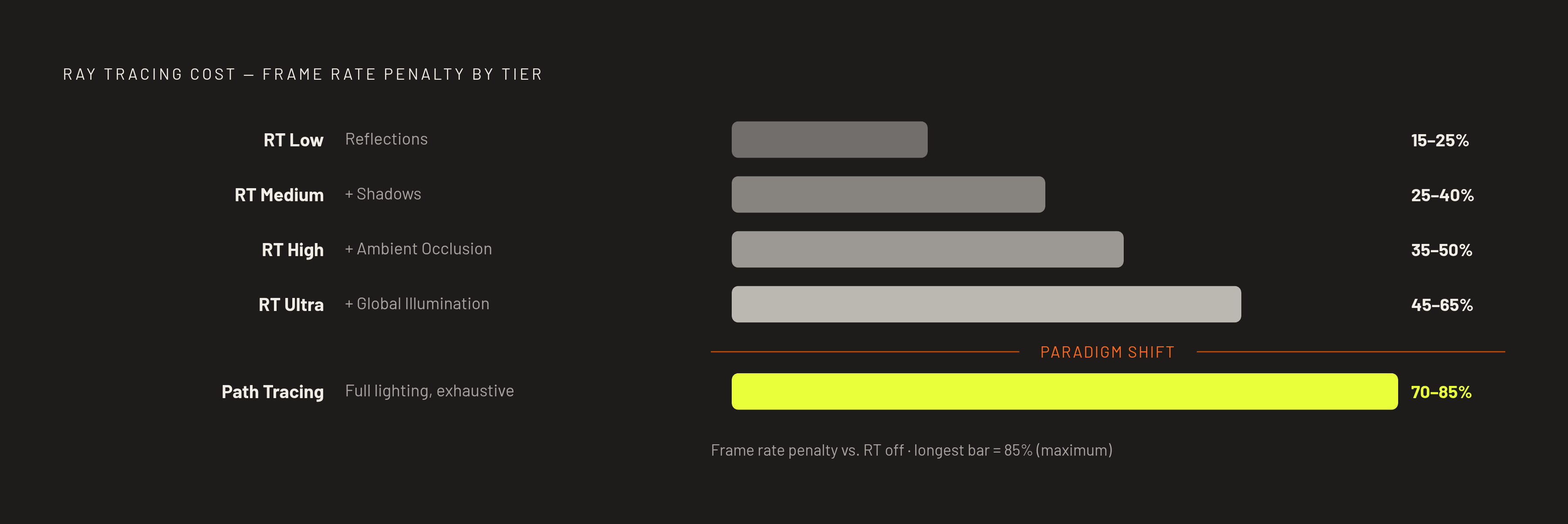
The phrase "RT penalty" means something different at every price point, because it depends entirely on which of the four ray-traced effects a builder actually turns on, and treating all ray tracing as one setting is the most common mistake in how builders plan around it. At RT Low, limited to reflections only, the frame rate reduction runs roughly 15 to 25 percent, a subtle visual change that most ray tracing-capable cards absorb without issue. At RT Medium, adding shadows to reflections, the cost runs roughly 25 to 40 percent, a tier that produces a clear improvement in interior scenes and stays viable at 1440p on mid-range hardware. RT High layers in ambient occlusion alongside reflections and shadows, which pushes the cost to roughly 35 to 50 percent, and this is where cards below the RTX 4070 or RX 9070 class start to feel real pressure. RT Ultra, which enables all four effects together, runs roughly 45 to 65 percent and delivers the strongest conventional ray tracing experience available, but it demands upper-midrange hardware even at 1440p. Path tracing stands apart from all of it: the frame rate cost runs 70 to 85 percent, a generational leap in visual fidelity that practically requires an RTX 4080 or better with upscaling for older titles, and an RTX 5080 or better for the path-traced games shipping in 2025 and 2026 at higher resolutions. The numbers from Alan Wake 2 show what that looks like in an actual game: an RTX 4090 running path tracing at native 4K on the High preset drops to 32 frames per second, and an RTX 4070 running the same settings at 1440p hits just 28 frames per second. So upscaling stops being optional the moment path tracing is involved. Path tracing has also moved from a showcase feature to a standard offering in 2026, shipping at launch in some titles while arriving as a post-release update in others, including 007: First Light, Resident Evil Requiem, Crimson Desert, and Control Resonant. The gap between what developers are now building toward and what most installed hardware can run natively keeps widening as a result.
Why upscaling makes RT viable below flagship tier
Upscaling isn't a bonus feature layered on top of ray tracing for builders below the flagship tier, it's the mechanism that makes ray tracing usable there at all, and that distinction should shape how a builder thinks about GPU selection from the start. The platforms aren't equal in how far that support reaches back. RTX 30-series cards still support DLSS Super Resolution, Ray Reconstruction, Nvidia Reflex, and the newer DLSS 4.5 transformer model, while AMD's frame generation, ray reconstruction, and radiance caching features are not available on pre-RDNA 4 hardware through AMD's official FSR driver path. That means an RX 7800 XT owner gets upscaling but not the full-pipeline ray tracing assist that an RTX 3080 owner has access to, despite the two cards competing in a similar performance class. The honest cost of relying on upscaling is latency. The strongest case against treating "RT is viable at mid-range with upscaling" as a settled fact comes down to what frame generation actually does: it inflates the number displayed on the frame counter while leaving input latency at its unassisted level. A builder enabling it is trading responsiveness for a higher frame rate on screen, not gaining both at once, and understanding that trade is part of understanding what ray tracing costs below the flagship tier.
RT value by GPU tier and game type
Whether ray tracing is worth turning on depends on more than the GPU in the build, it depends on what the builder is playing, and the right call for a competitive shooter player is often the opposite of the right call for a single-player builder spending the same amount of money. For single-player AAA titles at 1440p, ray tracing is worth enabling on RTX 4070-class or RX 9070-class hardware and above, with DLSS or FSR set to Quality. Below that tier, the frame rate cost outweighs the visual gain in most games. For competitive shooters such as CS2, Valorant, and Apex Legends, ray tracing should stay off regardless of GPU tier: the latency introduced by ray tracing pipelines and the upscalers that support them is a liability in reflex-dependent play, and the visual difference matters far less in fast-paced environments where split-second reaction beats fidelity. For path tracing specifically, the practical floor is an RTX 4080 running DLSS 3.5 Quality with Frame Generation enabled, the combination needed to reach playable frame rates at 1440p. Below that hardware tier, path tracing works as a benchmarking exercise, not something a builder would actually play through. At 4K, path tracing remains the territory of the RTX 5090 and RTX 5080 paired with upscaling, and even the RTX 4090 drops to 32 frames per second running Alan Wake 2 natively at High path tracing settings, a number that underlines how far 4K path tracing still sits from being hardware-agnostic.
VRAM and PSU: the build constraints RT quietly changes
Ray tracing changes more than which GPU a builder picks. It raises the minimum bar for VRAM and power supply capacity in ways that can quietly invalidate a build that looked sound on paper. The VRAM floor moves upward once ray tracing enters the picture: 8 GB has become a documented liability at 1440p in 2025 and 2026 titles running high textures or ray tracing, a limitation already visible on the RTX 5060's 8 GB configuration. Twelve gigabytes is the comfortable floor for 1440p ray tracing, but you need 16 GB for 4K path tracing to stay smooth without stutter. Valve's Steam Hardware Survey shows 16 GB VRAM GPUs overtaking 8 GB cards for the first time, reaching 25.90 percent of surveyed systems, with that lead extending further by August. Builders are already buying toward the higher buffer before games demand it. AMD has historically shipped more VRAM at equivalent price points than Nvidia, and the RX 7900 XTX's 24 GB against the RTX 4080's 16 GB is a real differentiator for builders who weigh VRAM headroom more heavily than raw ray tracing throughput. Power supply sizing deserves the same attention. Sustained ray tracing workloads push high-end GPUs near their rated power ceiling for extended stretches, and a PSU sized for a previous generation's power budget paired with an RTX 5080 or RTX 5090 is a real risk rather than a theoretical one, with mid-session brownouts a documented outcome of that mismatch. The RTX 5090 carries a 575W TDP and the RTX 5080 is 360W, and both numbers call for PSU planning that builders coming from older hardware may not have budgeted for. These are exactly the kind of mismatches that are easy to miss when a parts list is assembled piecemeal, and running a planned build through a compatibility checker before purchase, the kind of real-time check that flags a PSU or VRAM shortfall against the rest of a configuration, catches the problem before it becomes a support ticket after the parts arrive.
Installed base and the direction of RT development
Looking at what GPUs the installed base actually runs explains why games get built around ray tracing the way they do, and it gives a builder a realistic sense of what their hardware tier means relative to where developers are putting their engineering effort. The RTX 5070 climbed to 5.86 percent of the surveyed GPU pool in September 2026, up 2.30 percentage points in a single month, making it the single most common graphics card on Steam. The mid-range ray tracing tier is where the mass market has actually landed. The RTX 40-series holds roughly 35 percent of RTX users and the RTX 30-series roughly 33 percent, so close to 68 percent of all RTX owners sit in the standard ray tracing with upscaling tier rather than the path-tracing tier, and that's the audience developers build their ray tracing implementations around. That installed-base reality shapes how developers prioritize their engineering time: because most players run ray tracing at mid-range settings with upscaling active, developers optimize primarily for that mode, reinforcing upscaling's role as a structural part of the ray tracing pipeline rather than an optional add-on, while native-resolution ray tracing optimization gets comparatively less attention. Path tracing has moved from a showpiece feature to a launch-day staple in 2026 across titles including 007: First Light, Resident Evil Requiem, Crimson Desert, and Control Resonant, yet the RTX 5090 still averages only 22 to 25 frames per second in 007: First Light at native 4K. Hardware has not caught up to what developers now ship as a standard feature. The takeaway for a builder planning a purchase in 2026 is that the mid-range ray tracing tier, RTX 4070-class or RX 9070-class hardware paired with upscaling, is where the majority of the optimized ray tracing experience actually lives. The path-tracing ceiling keeps rising and will keep rising, but the realistic floor for enjoying ray tracing today is the same tier developers are already building for. A builder who understands where that installed base actually sits is working from the same baseline developers are optimizing against, and that's a sturdier position to buy from than chasing the ceiling alone.