Best GPUs for 1440p Gaming by Price Tier
AI upscaling lets mid-range GPUs hit high frame rates at 1440p in 2026.

Summary
AI upscaling lets mid-range GPUs hit high frame rates at 1440p in 2026.
Best GPUs for 1440p Gaming by Price Tier.
1440p as the resolution to build around in 2026
Picking a GPU for 1440p gaming now means matching a budget tier to a performance and VRAM threshold that this resolution actually demands, and every price band in 2026 has a card that answers that demand clearly. It's enough of a jump over 1080p that the sharpness is obvious the moment you sit down in front of a panel, but it doesn't demand the graphics horsepower that 4K does. That gap is the whole story.
That sharpness appears most on 27 inch panels, the most popular gaming monitor size, and the display ecosystem has built itself around this exact pairing of screen size and resolution. The monitor side of this equation isn't some niche corner of the market either.
What's changed the calculus most is the refresh rate expectation baked into that monitor market. Most 1440p panels on shelves right now ship at 144Hz or faster as a default, not an upsell, which means the GPU target isn't a steady 60 frames a second anymore, it's holding 100-plus frames consistently. That's a meaningfully higher bar than what buyers were aiming for a GPU generation or two back.
AI upscaling has quietly redrawn what "mid-range" even means at this resolution. A card sitting a tier below the flagship can now push high frame rates once DLSS 4.5 or FSR Redstone gets switched on, closing gaps that used to require raw silicon to close. Monitor market context frames this shift: a 27" 1440p 165Hz IPS panel runs $200–300, while a 240Hz OLED costs around $600–800, making these mature, widely available options rather than exotic gear. With no BuildCores product placement in this scene-setting section, the discussion closes by framing the question the rest of the guide answers: which GPU tier makes sense for your budget.
The VRAM floor that every 1440p buyer needs to understand first
Before any tier-by-tier comparison, how much memory a card has needs settling, because it decides whether a card is even a candidate. Newegg Insider's own testing, echoed by independent reviewers across the space, puts 12GB as the comfortable working baseline for 1440p in 2026, with 16GB the number to aim for if the plan is to keep the card a while. Recent releases document this concern repeatedly. It's documented, repeatedly, across recent releases.
Alan Wake 2 and Call of Duty: Black Ops 7 go further still, using over 12GB at 1440p with high-resolution textures enabled. TechSpot's VRAM analysis, cited by Newegg Insider, adds useful nuance here rather than blanket alarm: Cyberpunk 2077 with the Phantom Liberty expansion is actually well-optimized for 8GB cards at 1440p ultra as long as ray tracing stays off, though turning ray tracing on changes that math fast. Avatar: Frontiers of Pandora runs around 12GB or more at ultra settings, and Senua's Saga: Hellblade II manages to exceed 8GB even at the merely High preset, not even Ultra.
Ignoring this raises specific, ugly problems. The 8GB version of the RX 9060 XT has been shown stuttering, dropping frames, and popping in textures mid-scene once it runs into its own memory ceiling. So the rule here is a plain one: for AAA gaming at 1440p with max settings, only the 16GB SKUs are a safe bet in 2026, and that includes ruling out the 8GB variants of both the RX 9060 XT and the RTX 5060 Ti, both of which are compromised options at this resolution.
That said, VRAM capacity alone doesn't settle the argument, and treating it as the only number that matters would be a mistake. Bandwidth and capacity both do work, and a full accounting has to weigh both. Frame generation, whichever vendor's version, can paper over some raw performance gaps between cards, but it cannot fix a memory shortage. A card that stalls because it's run out of VRAM will stutter no matter what upscaling tier gets layered on top of it. With that floor established, the rest of this guide works up from the entry point, tier by tier. Black Myth: Wukong, Indiana Jones and the Great Circle, and Cyberpunk 2077 regularly exceed 8GB at 1440p Ultra. Raw VRAM capacity matters alongside bandwidth: 16GB of slower GDDR6 versus 12GB of fast GDDR7 is a genuine trade-off, not a simple more-is-better equation, so readers shouldn't over-index on the number alone.
Entry 1440p (well under budget): Intel Arc B580 12GB
It runs on Intel's Battlemage architecture, with 12GB of GDDR6 on a 192-bit bus and a 2740MHz core clock, drawing power through a single 8-pin connector on a compact two-slot, 249mm card with DisplayPort 2.1 outputs, and Intel recommends a 650W power supply to run it. As of PC Gamer's August 21, 2026 update, street pricing puts the B580 at $310 through Newegg, while fpsperdollar.org tracks it delivering 42.3 average frames per second at 1440p Ultra, at a market price closer to $343 in their own tracking.
What the B580 gets right matters more than its raw numbers suggest. That 12GB buffer clears the 8GB cliff described above entirely, which means it sidesteps the stutter and texture pop-in problems that plague cheaper 8GB cards at this resolution. Intel's XeSS 3 frame generation adds real upside on top of that, and the card's small physical footprint means it drops into tight cases without a fight.
None of that erases its ceiling, and that ceiling sits where the following numbers show. Tom's Hardware doesn't place Battlemage anywhere near its top 1440p recommendation tier, and TechFuelHQ's own tier ranking scores it a 30.3, the lowest of any card covered in this guide.
fpsperdollar.org reports the B580 delivers 42.3 avg FPS at 1440p Ultra at a current market price of about $343. It suits builders on a tight budget moving off 1080p who want 1440p capability today, with a GPU upgrade planned down the road, and it's a credible choice for anyone whose game library leans toward esports titles or older AAA games that don't tax a GPU heavily. What the B580 demonstrates, more than anything, is that 12GB of memory matters more at entry level than a pile of extra shader cores, and the next tier up shows what happens once both improve at the same time. As PC Gamer notes, the Arc B570 holds its "Best budget" recommendation slot, while the B580 is also listed, so both cards make the cut.
Budget 1440p (a moderate street price range): RX 9060 XT 16GB vs. RTX 5060 Ti 16GB
Move up to this tier and the two 16GB cards worth comparing land close enough in raw raster performance that picking between them stops being about frame rate. Pricing tells a more interesting story. PC Gamer's tracking shows the RX 9060 XT 16GB at $470 through Newegg, against $780 for the RTX 5060 Ti 16GB at Walmart specifically, though that Walmart figure runs well above what Newegg and Amazon are asking, so it's worth cross-checking retailers before assuming that's the going rate.
In a benchmark from Tom's Hardware, using AMD's own evaluation data, the RX 9060 XT hit 134 frames per second at 1440p against the RTX 5060 Ti's 142, a 5% gap in that particular test.
AMD's case rests on value and efficiency. AMD also points to a 46% average performance uplift over the previous RX 7600 XT across more than 30 games tested, a case that this generation is a genuine step forward rather than a rebadge with a new sticker. Community sentiment leans hard toward AMD here too: a TechPowerUp poll drawing more than 16,000 votes saw the RX 9060 XT take over 8,500 of them, against roughly 3,500 for the RTX 5060 Ti.
Skip the 8GB versions of either card if 1440p AAA gaming is the goal; the 8GB RX 9060 XT and 8GB RTX 5060 Ti are D-tier options for this resolution. Card size matters more in this tier than it might seem, too. The SAPPHIRE PULSE's compact 240mm footprint and the larger ASUS PRIME sit at genuinely different ends of what fits inside a given case, so that detail needs confirming against case clearance before money changes hands. The core parity finding is that at native 1440p raster, both cards average roughly 78 FPS across an eight-game test suite, within 1% of each other. The RX 9060 XT 16GB runs about $448 street, up to roughly $509, against an MSRP of $349. The RTX 5060 Ti 16GB runs about $564 street, up to roughly $635, against an MSRP of $429. The gap amounts to approximately $115 at street, with both cards priced above MSRP due to the ongoing GDDR shortage. The research specifically calls out the SAPPHIRE PULSE Radeon RX 9060 XT 16GB, featuring 2048 RDNA 4 stream processors, a 3290MHz boost clock, 16GB of GDDR6, 170W board power, a single 8-pin connector, a 240mm 2.3-slot design, a 450W PSU requirement, and the full FSR Redstone suite exclusive to RDNA 4. Where NVIDIA pulls ahead:. In ray tracing, the 5060 Ti runs approximately 14% faster in Cyberpunk 2077 at 1440p with upscaling, with the gap widening past 25% in full path tracing in Alan Wake 2. DLSS 4.5 with Multi Frame Generation and local AI workloads. A $115 lower street price delivers equivalent raster performance.
Mid-range 1440p (a higher street price range): RTX 5070 vs. RX 9070
Stepping up again repeatedly widens the performance gap over the budget tier from marginal to real. Tom's Hardware's 1440p ultra rasterization index, cited by Newegg Insider, puts the RTX 5070 about 31% ahead of the RTX 5060 Ti 16GB, and the RX 9070 another 8% ahead of the RTX 5070 in that same index. It runs 12GB of GDDR7, fast enough memory that it mitigates most (though not all) of the capacity concerns that would otherwise apply to a 12GB card. The MSI RTX 5070 Gaming Trio OC runs 12GB GDDR7 on a 192-bit bus, a 2610MHz boost clock, a 16-pin power connector, and a 338mm triple-fan cooler that wants a 650W power supply. Pricing, though, spreads wide by retailer: Newegg Insider had it starting at $609.99 as of August 2026, while PC Gamer's price tracker showed $763 through Amazon at the same time, a gap large enough that it's worth checking current listings before assuming either number holds.
PC Gamer notes it delivers performance close to the RX 9070 XT at current street prices. The PowerColor Reaper Radeon RX 9070 16GB is the specific card to know: a 256-bit bus, dual 8-pin power connectors, and a compact two-slot, 289mm design needing a 650W supply. Street price is around $650 through Newegg per PC Gamer's tracking, and fpsperdollar.org clocks it at 86.3 average frames per second at 1440p Ultra, around a $668 price point in their own data.
The real tension in this tier isn't really about which card is faster. Tom's Hardware's 1440p ultra rasterization index, cited in Newegg Insider, puts the RTX 5070 about 31% ahead of the RTX 5060 Ti 16GB, while the RX 9070 is about 8% ahead of the RTX 5070 in that same index. Anyone leaning into ray tracing, or simply planning to keep the card past this console generation's usual shelf life, should weigh the RX 9070's extra headroom seriously. The upscaling ecosystems diverge here as well, and this is where each vendor locks in loyalty. Both feature sets are locked to their respective architectures, RDNA 4 on one side and Blackwell on the other, so neither is available on older hardware from the same brand. For most builders, this tier represents the sensible ceiling of 1440p spending, but for anyone chasing a 240Hz panel or leaning hard into ray tracing, there's one tier left to consider. It averages 110–130 FPS at 1440p ultra settings natively, with DLSS 4 and Multi Frame Generation pushing well beyond 144 FPS. The RX 9070 holds PC Gamer's current pick for best overall graphics card, in an article updated August 21, 2026. Its 16GB of GDDR6 on a 256-bit bus provides 4GB more VRAM than the RTX 5070, meaningful for ray tracing and future-proofing. Also available is the RX 9070 GRE at $500 at Newegg per PC Gamer, delivering 70.9 average FPS at 1440p Ultra per fpsperdollar.org at roughly $596, making it a viable middle-ground step. The 12GB versus 16GB trade-off is the live tension in this tier, pitting the RTX 5070's GDDR7 speed against the RX 9070's larger buffer, with the RTX 5070 winning for raster-focused builders and the RX 9070's extra headroom worth considering for ray tracing and future-proofing.
High-refresh 1440p (~$720–$1,100 street): RX 9070 XT vs. RTX 5070 Ti
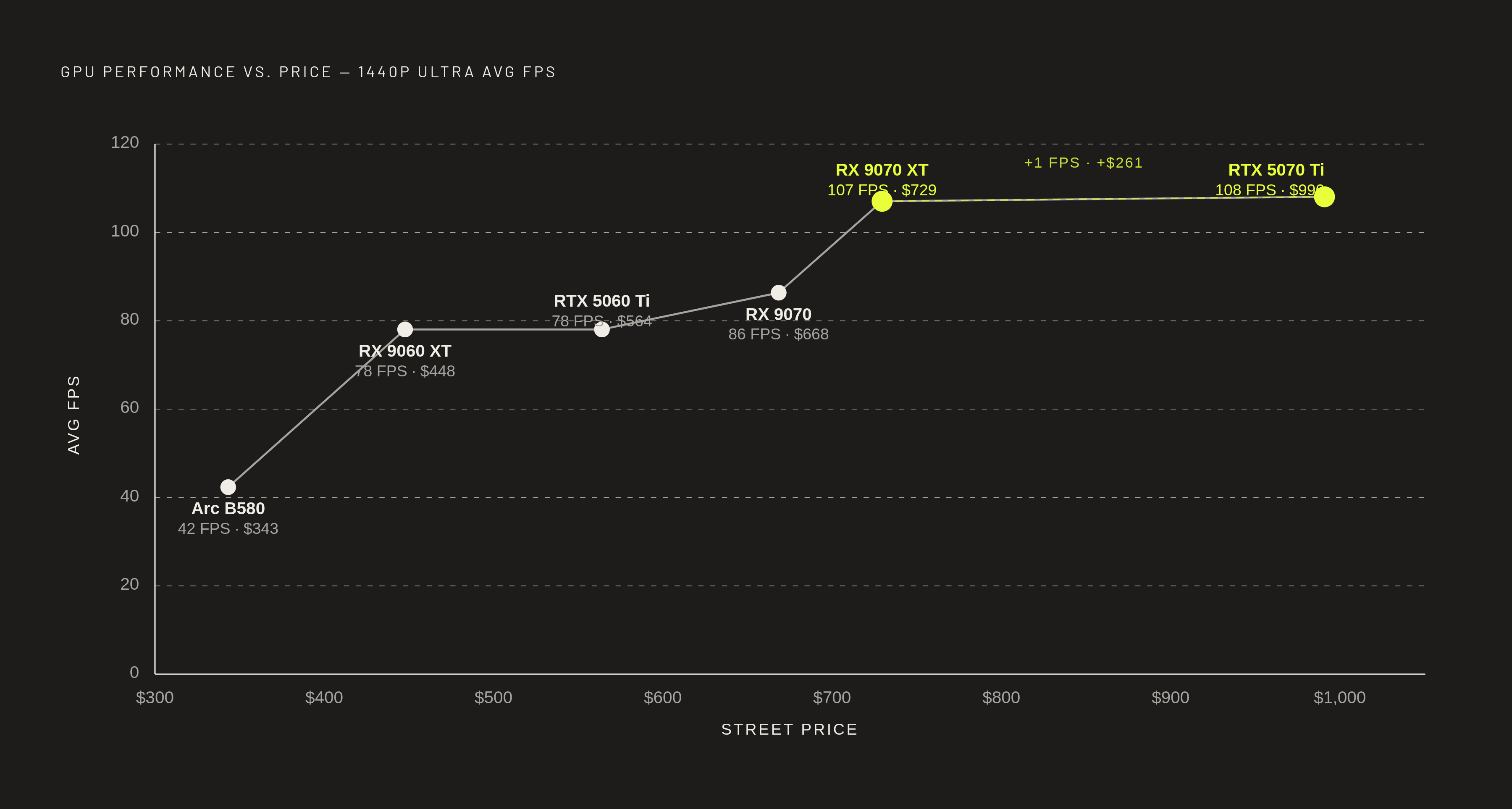
At the top of what counts as sensible 1440p spending, the RX 9070 XT and RTX 5070 Ti land close enough in performance that the decision comes down almost entirely to price. TechSpot's 52-game comparison has the RX 9070 XT averaging 107 frames per second at 1440p against the RTX 5070 Ti's 108, a statistical dead heat by any reasonable reading. Tom's Hardware's own 1440p ultra index, as cited by Newegg Insider, backs that up almost exactly: the RTX 5070 Ti at 69.8%, the RX 9070 XT at 69.7%.
GamersNexus put a sharp number on exactly what that buys: at MSRP, the $600 RX 9070 XT delivers 95% of the RTX 5070 Ti Prime's performance for 80% of its price. For most builders chasing high-refresh 1440p, that math is hard to argue against, though anyone whose workload leans specifically on Nvidia's ray tracing and AI feature set still has good reason to pay the premium https://www.redswitches.com/blog/13-best-gpus-for-gaming-in-2026/. The RX 9070 XT launched at $599 SEP, with late July–August 2026 street pricing around $719–$739, and PC Gamer showing $720 at Amazon. The RTX 5070 Ti runs at street prices of roughly $880–$1,100, with PC Gamer showing $1,088 at Amazon and Newegg listings in August 2026 around $1,099.99.
Sources
- The RX 9070 remains my pick for best graphics card, but in the budget market Nvidia
- Best Graphics Cards for 1440p Gaming in 2026
- Best GPUs for 1440p Gaming 2026: Ranked by FPS per Dollar
- tomshardware.com
- GeForce RTX 5070 vs. Radeon RX 9070 XT: 2026 Update | TechSpot
- Best Graphics Cards for Gaming in 2026
- techfuelhq.com
- gamersnexus.net