RTX 4070 vs RX 7800 XT for 1440p Gaming
The 4070 wins on ray tracing and upscaling; the 7800 XT barely leads in raw frame rates.

Summary
The 4070 wins on ray tracing and upscaling; the 7800 XT barely leads in raw frame rates.
Why these two GPUs still define the 1440p mid-range
The RTX 4070 and RX 7800 XT launched five months apart in 2023, at $599 and $499, and that $30-ish gap in typical street pricing shaped how a whole generation of builders chose between them. Three years on, both cards are gone from shelves as new products, pushed into clearance bins and used listings by RTX 50 and RX 9000 hardware. That doesn't make them irrelevant. Steam's hardware survey in 2026 still lists the RTX 3060, a card from an earlier generation than either of these, as the single most common GPU in the install base, at roughly 3.99% share. Most computers running games right now sit nowhere near the cutting edge, and for a builder trying to leave that install base behind on a budget, the 4070 and 7800 XT are still the two most sensible steps up.
They also represent two different bets about where gaming performance was headed. Nvidia built the 4070's architecture around accelerated rendering, dedicated ray-tracing hardware, and squeezing more frames out of fewer watts. AMD's RDNA 3, in the Navi 32 die that powers the 7800 XT, bet on raw rasterization throughput and generous memory capacity instead. Both bets paid off, in different currencies, and the question of which card "wins" in 2026 comes down to which currency a given builder is spending in. The honest answer, laid out below, is that the 4070 has aged into the better all-around purchase, because the ground it was built on keeps shifting in its favor while AMD's has gone flat, even though it usually isn't faster.
Core specs that explain every downstream tradeoff
The RTX 4070 carries 12 GB of GDDR6X on a 192-bit bus, backed by 36 MB of L2 cache, and draws up to 200 watts. The RX 7800 XT carries 16 GB of GDDR6 on a wider 256-bit bus, backed by 64 MB of on-chip cache, and draws up to 263 watts.
Every comparison in this piece traces back to those four numbers. AMD's wider bus and much larger cache explain why the 7800 XT generally leads in raw rasterized frame rates: more cache means fewer trips out to memory, and a wider bus moves more data per cycle when a trip is unavoidable. Nvidia's GDDR6X runs faster per pin than AMD's GDDR6, which claws back some of that bandwidth deficit despite the narrower bus, and that trade is most visible in workloads that lean on Nvidia's dedicated ray-tracing and tensor hardware rather than brute-force pixel throughput.
The connector difference matters beyond the spec sheet: it can cause a returned part if skipped. The 4070's single 12VHPWR plug looks clean in a windowed case but has connector compatibility requirements worth checking against an existing power supply before purchase. The 7800 XT's dual 8-pin setup is uglier in a cable window but works with almost any ATX power supply built in the last decade. For anyone reusing an existing PSU, that's a real compatibility variable, not a cosmetic one.
Rasterization at 1440p: what the frame-rate gap looks like
In pure rasterization, the 7800 XT wins, and the margin holds fairly steady across independent test suites. One widely cited benchmark run puts AMD's lead at 5% at 1080p, 7% at 1440p, and 8% at 4K, widening slightly as resolution climbs and the wider memory bus starts to carry more weight. A separate 11-game suite at 1440p put the average AMD lead at 6%, which lines up closely and points to a real-world gap sitting somewhere in the mid-single digits.
In actual frame rates: at 1440p Ultra settings, per-game FPS data puts the 7800 XT at an average of 115 fps against the 4070's 106. That's a real difference, but the kind you notice on a frame counter more readily than in how a game actually feels to play. One more aggressive estimate puts AMD's lead as high as 10 to 15% in rasterized titles at 1440p, which reads as the upper bound of what's been reported rather than a typical result. Across the range of data, the fair summary is that the 7800 XT runs a mid-single-digit-to-low-double-digit percentage faster in games without ray tracing, and that gap holds steady from 1080p through 4K. It just doesn't matter as much as it looks like it should, for reasons the next two sections make clear.
Ray tracing: where the RTX 4070 reverses the result
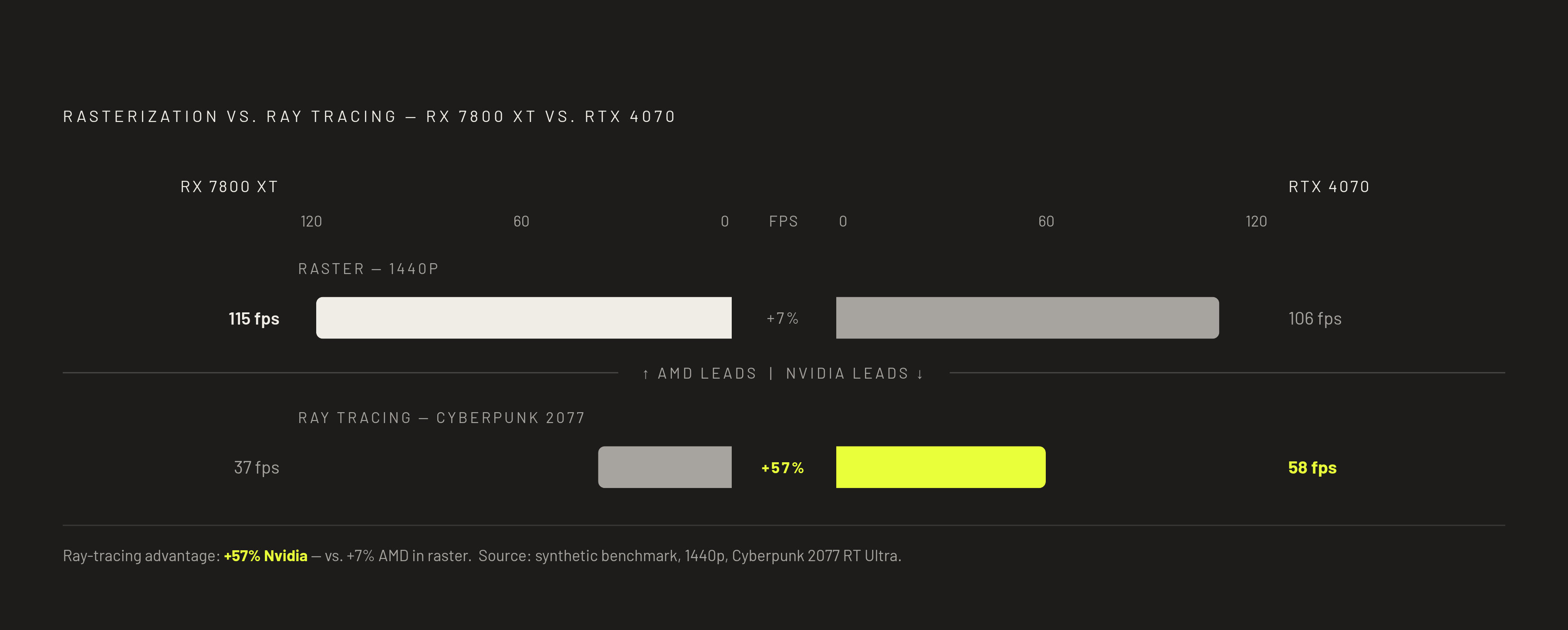
Ray tracing being switched on flips the picture completely. In Cyberpunk 2077 with ray tracing enabled at 1080p, the RX 7800 XT managed 37 fps against the RTX 4070's 58, a 57% gap in Nvidia's favor. That 21-frame gap is not a rounding difference; it's the difference between a game that feels fluid and one that does not.
How large that gap gets depends on how much ray tracing a given title asks the GPU to do. One broader analysis puts the 4070 as more than 50% faster in the heaviest RT titles, while a mixed suite covering lighter ray-tracing workloads at 1080p and 1440p shows the 4070 ahead by a more modest 5 to 10%. Another source, testing titles like Cyberpunk 2077 and Control, found the 4070 ahead by up to 20%, landing in the middle of that range. The pattern holds even when the magnitude shifts: The magnitude of Nvidia's lead varies with how aggressively ray tracing is applied in a given title, from the modest end of that range up toward the 57% figure from Cyberpunk. Ray tracing performance isn't one number, it's a spectrum, and the 7800 XT sits at a disadvantage across most of that range. Anyone shopping between these two cards with ray tracing as a real priority should stop looking for a single verdict and instead ask which end of that spectrum their game library actually lives on.
Upscaling in 2026: why the RX 7800 XT is now two generations behind
Raster and ray-tracing numbers are snapshots taken at a moment in time. Upscaling is a trajectory, and it's where the gap between these two cards has widened the most since 2023.
The RTX 4070 runs Nvidia's current transformer-model upscaler, available across more than 400 titles through an override in the NVIDIA App, plus frame generation exclusive to RTX 40-series hardware and newer. DLSS 4 marked a real architectural shift, moving from a convolutional neural network to a transformer-based model, and in motion, fine detail like chain-link fences, foliage, and small text holds together as the camera moves, instead of dissolving into the shimmering mess older upscalers produced.
The RX 7800 XT is capped at FSR 3.1. AMD's newer FSR 4, and the March 2026 release of FSR 4.1 with sharper machine-learning-based reconstruction, are both locked to the RX 9000 series. A 7800 XT owner in 2026 cannot access either one, no matter how recent the driver. A July 2026 head-to-head from Daniel Owen tested both cards natively and with their respective upscalers across a slate of 2025 and 2026 titles, and it's the most current real-game evidence of how far the two technologies have drifted apart.
Nvidia's announcement of DLSS 5 at GTC 2026 deepens that split further. Described as moving beyond upscaling into neural rendering of lighting and material detail, DLSS 5 launches in fall 2026, exclusively for the RTX 50 series. It has no bearing on a 4070 purchase today, but it previews the same pattern repeating: Nvidia's software layer keeps compounding generation over generation, while AMD's older cards get locked out of each new version the day it ships.
This is the single most important long-term factor separating these two cards in 2026. The raster gap between them is moderate and has stayed essentially flat since launch. The upscaling gap is structural, tied to hardware generations rather than driver updates, and it only widens from here. A builder weighing "faster today" against "further behind every year" is not weighing two equal things.
Power draw, thermals, and what 63 watts costs a build
The 7800 XT draws up to 263 watts under load, the 4070 up to 200. Sixty-three watts sounds trivial until it's translated into the parts sitting around the GPU.
Power supply headroom is affected first, before other components. A 650-watt unit is comfortable for a 4070 build paired with most mid-range CPUs. The 7800 XT wants more headroom, depending on the processor riding alongside it, and skimping here is how builders end up chasing phantom instability, random shutdowns under load that look like a GPU fault but are actually a PSU running out of headroom. Heat is the second cost. Sixty-three watts of extra sustained load doesn't sound like much on paper, but in a small-form-factor case or a mid-tower with average airflow, it's the difference between fans that stay quiet and fans that ramp constantly. Stretched across a multi-year ownership period, that same 63-watt gap raises the electricity bill; the exact dollar figure depends on local rates and hours played, but the direction never flips: the 4070 costs less to run, every day it's switched on.
The connector issue from earlier resurfaces here too. The 7800 XT's dual 8-pin setup is the easier path for anyone reusing an older, non-ATX 3.0 supply. The 4070's single 12VHPWR cable routes cleaner through a windowed case, but it adds a compatibility check the 7800 XT simply doesn't require. Build-planning tools that flag PSU wattage and connector types during parts selection exist precisely because this friction trips up builders who assume any supply with "enough watts" will do the job.
VRAM headroom requirements
Steam's hardware survey shows 16 GB GPUs at 25.90% of tracked systems, just ahead of 8 GB cards at 25.32%. A month earlier, 16 GB cards held 24.50%, a gain of roughly 1.4 percentage points in a single month. That's a fast-moving line, and it points one direction: 16 GB is turning into the baseline expectation for a serious gaming PC, not a luxury tier reserved for flagship cards.
That trend is the real argument for the 7800 XT's 16 GB buffer, and it's the one place the card's slower long-term trajectory doesn't apply. At standard 1440p settings, both cards run current titles without hitting VRAM limits, so the extra 4 GB buys nothing most days. It occurs the moment someone maxes out texture settings, installs heavy texture mods, or pushes either card toward 4K output despite that not being the target resolution: that's where 12 GB starts to choke and 16 GB doesn't. The extra buffer matters most when pushing toward 4K output or heavy texture mods, which isn't the use case most 4070 or 7800 XT buyers have in mind, but the 4070's 12 GB ceiling is the spec most worth watching over a longer ownership window, for anyone planning to keep the card rather than upgrade again in a year or two.
Pricing in 2026: a market that no longer resembles launch day
At launch, the 7800 XT cost $499 and the 4070 cost $599, and AMD's discount made the value case straightforward in its favor. That math doesn't apply anymore. Tracked pricing as of late September 2026 puts the RX 7800 XT at roughly $894, a figure almost certainly inflated by tariff effects and secondary-market dynamics rather than a stable retail price, and it should be read as a snapshot of a volatile market rather than a number to build a purchase decision around.
Two value analyses reach opposite conclusions, and the reason affects which currency a builder is weighing when deciding which card "wins." One analysis, using current retail pricing, finds the RTX 4070 offers 13.6% better value: the 7800 XT's 11.2% synthetic benchmark lead doesn't come close to justifying being 27.3% more expensive to buy today. Another analysis, using original MSRP instead of current retail price, finds the RX 7800 XT delivers 13% better value for money. Both are correct. They're measuring two different markets, one reflecting what a shopper pays right now, the other reflecting launch-day economics that no longer exist anywhere but in the history books. Anyone comparing these two figures without knowing which market they're each drawn from will walk away confused, reasonably so.
The more useful path for most builders in 2026 runs through the used and clearance market that's opened up as owners trade up to RTX 50 and RX 9000 hardware. A patient buyer working secondhand listings can likely land either card well under the figures above. Once price gets pulled out of the equation, the 4070's lower power draw and stronger upscaling support make it the safer used purchase: it asks less of the rest of the system, and it has a longer runway of software support ahead of it than a card already locked out of FSR 4.
Which card fits which builder
Neither card is a universal answer, and treating one as the automatic winner would misread what the data actually shows. The right choice depends on which tradeoff a builder can actually live with for the next three or four years.
The RX 7800 XT makes sense for someone chasing pure rasterized frame rate at 1440p, who mostly plays titles without heavy ray tracing, who wants the 16 GB buffer for texture mods or a long ownership window, and whose power supply and case can comfortably handle a 263-watt card. The RTX 4070 makes more sense for someone whose library leans on ray tracing, who values what DLSS 4 and frame generation actually do to image quality in motion, who's building in a smaller case or keeping an older power supply, and who wants a card that runs cooler and cheaper for as long as it stays installed. Both are legitimate, well-built answers, but they're answers to different questions, and a builder who picks the 7800 XT for its frame-rate lead while ignoring that its upscaling support is already locked out of AMD's newest generations is solving for the wrong variable.