DDR5 vs DDR4 RAM for Gaming Builds Today
DDR5 dominates new platforms while DDR4 still works at 1440p and higher resolutions.

Summary
DDR5 dominates new platforms while DDR4 still works at 1440p and higher resolutions.
The old framing doesn't apply anymore. For years, builders treated DDR5 versus DDR4 as a straightforward tradeoff: DDR5 ran faster and cost more, DDR4 ran slower and made financial sense for anyone not chasing benchmark numbers. That framing got settled, and not by anything a benchmark suite turned up.
Two things collided to change the terms of the decision entirely. First, DDR5 stopped being an option and became a requirement: DDR5 became the mandatory standard on every new platform.
Put those together and the practical result is this: for most builders, memory type gets decided the moment they pick a CPU platform, long before anyone opens a spreadsheet to compare speeds or dollar-per-gigabyte figures. What follows works through that platform lock-in first, then what the actual frame-rate difference looks like at different resolutions, then the pricing crisis itself, and finally how to match a scenario, not a spec sheet, to the right call. Each section builds on the one before it. There's no benchmark chart in this opening section because there doesn't need to be. The debate has moved to a different battlefield.
Platform compatibility determines memory type before performance enters the picture
Start with what's actually on the market. AMD's AM5 socket takes DDR5 only, no DDR4 option exists, and it covers the Ryzen 7000, 8000, and 9000 series. If a builder has a stack of DDR4 sticks sitting from a previous build, those sticks are dead weight on both of these platforms; neither one will take them.
That chip, notably, is still the practical ceiling for anyone building or upgrading on AM4 today.
Then there's the one platform that doesn't force a binary choice. Intel's LGA1700 socket supports either DDR4 or DDR5, depending on which motherboard a builder picks. That flexibility is exactly why Tom's Hardware used LGA1700 exclusively when it ran its mid-2026 study on the DDR4 gaming gap: it's the only place where both DDR4 and DDR5 are supported depending on board choice, making a true apples-to-apples comparison possible.
Upgrading from AM4 to AM5, or to LGA1851, means a full platform rebuild for anyone moving off an older DDR4 system. It's a full platform rebuild, since the DDR4 sticks simply won't fit the new socket's memory controller.
Longevity plays into this too. For builders using configurator tools during the planning stage, the platform choice itself typically determines which memory standards even show up as valid options, and the constraint gets surfaced before a single component gets added to a cart. DDR5-only platforms in 2026 shape the memory decision before performance considerations even enter the picture. Intel Arrow Lake and Arrow Lake Refresh, built on the LGA1851 socket, support DDR5 only.
The performance difference between DDR4 and DDR5 at different resolutions
The numbers get specific, and they also get conditional. The honest headline is that DDR5's gaming performance advantage is genuine at 1080p on powerful CPUs and in CPU-bound titles, but is largely academic at 1440p and above, rather than some single number that applies everywhere.
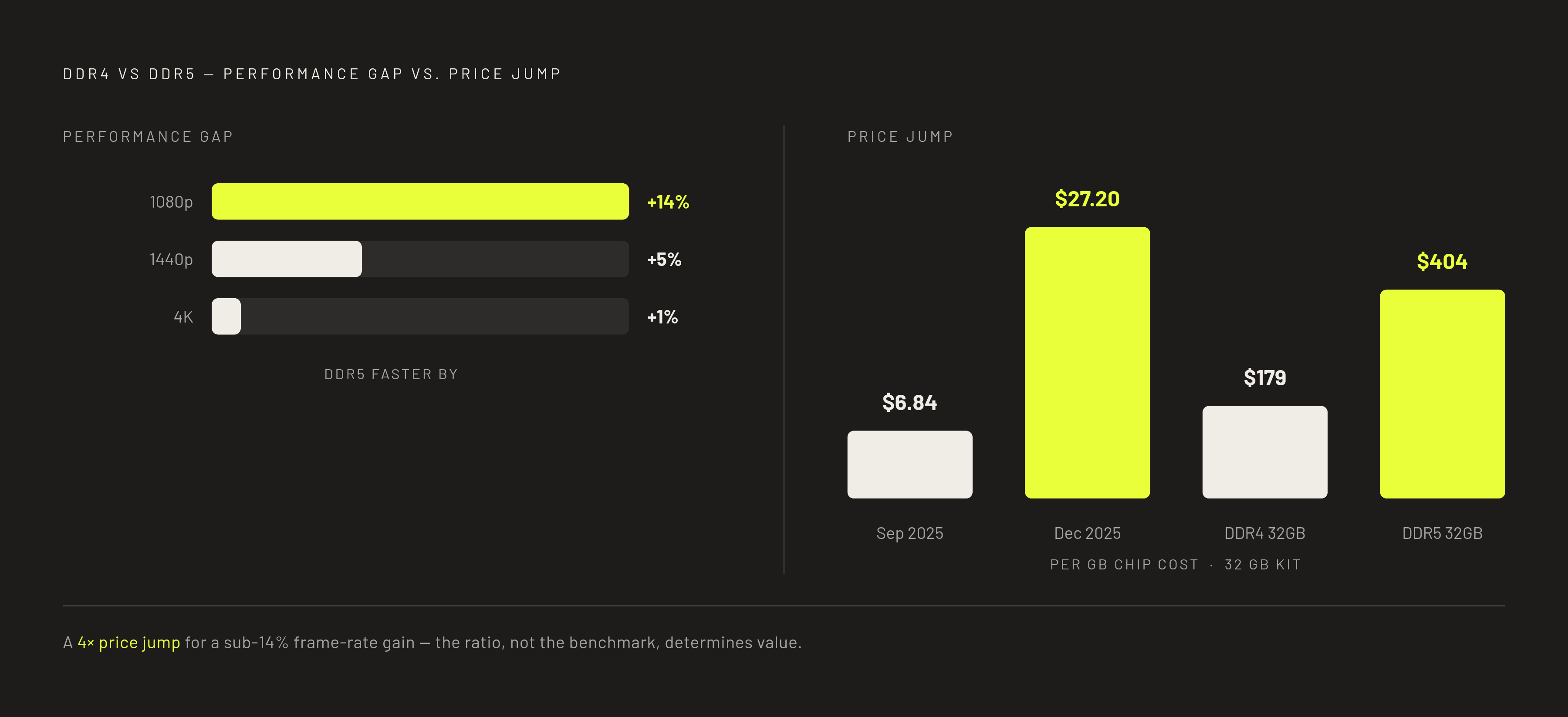
At 1080p, where the CPU tends to be the bottleneck rather than the graphics card, the gap is real and measurable. Tom's Hardware's re-examination of Intel's LGA1700 CPUs found DDR4 running about 14% slower on average across a 15-game suite. Individual results underline that this isn't noise: the i7-13700K lost 13.7% running Crimson Desert on DDR4 (a single-game figure, not the suite average), and the i5-14600K dropped 13.2% Tom's Hardware. What's notable in that dataset is the direction of the trend, not just its size. The penalty grows as the CPU gets more powerful, moving from around 9% on older 12th-gen chips up toward 14% on 13th and 14th-gen parts Tom's Hardware. DDR4 becomes more of a bottleneck, not less, as the processor it's feeding gets faster Tom's Hardware. Some CPU-bound titles, particularly certain competitive and open-world games, pushed penalties well past that 14% average Tom's Hardware.
Move up to 1440p or 4K, where the graphics card is doing most of the limiting, and the picture flips. The real-world gap drops to somewhere around 1% to 5% at 1440p, and often under 3% at 4K tomshardware.com. NoobFeed's January 2026 budget-build test backs this up directly: a Core i5-14600KF paired with DDR4 averaged 88 fps at 1440p in Red Dead Redemption 2, with no memory-related bottleneck showing up across the titles tested. Club386's February 2026 comparison, run with an MSI GeForce RTX 5070, illustrates the same mechanism from a different angle: at GPU-limited resolutions, the graphics card dominates the outcome and the memory gap gets compressed almost out of view.
That's outdated criticism about a latency wrinkle that keeps circulating. That's no longer the state of the market. Newegg's April 2026 analysis found mainstream DDR5-6400 kits running CL32 now deliver both more bandwidth and latency that's comparable to or better than DDR4-3600 CL16. The catch is that real gains from DDR5 begin at roughly 5,600–6,000 MT/s with CL30 timings or tighter; slow, base-spec DDR5 narrows the advantage.
Put together, the performance case for DDR5 is genuine, but it's conditional on the use case. At 1080p on powerful CPUs, or in CPU-bound titles specifically, DDR5's gaming performance advantage is genuine. At 1440p and up, it's close to academic, and a builder chasing GPU-bound gaming at higher resolutions is paying for a performance gain they won't actually see. First-generation DDR5-4800 at CL40 had higher absolute latency than DDR4-3600 CL16, eroding its bandwidth advantage.
The 2026 DRAM supply crisis's effect on prices for both standards
The performance conversation is, frankly, the easy part. The pricing situation is where things get genuinely disruptive, and it traces back to a single cause: Samsung, SK Hynix, and Micron, the three companies that make almost all the world's DRAM, have been shifting fab capacity toward high bandwidth memory (HBM) for AI datacenter GPUs. HBM and consumer DDR5 draw on the same manufacturing capacity, so every wafer redirected to an AI accelerator is a wafer not making a gaming memory kit.
The numbers on DDR5 tell the story bluntly. Chip-level prices climbed from $6.84 per GB in September 2025 to $27.20 per GB by December 2025, roughly a fourfold jump tech-insider.org. By August 24, 2026, Tom's Hardware's RAM price index had the cheapest available 16GB DDR5 kit at $214, and the cheapest 32GB kit at $404. Germany's 3D Center retail index, tracking DDR5 pricing against a July 2025 baseline, hit 486% of that baseline in August 2026, up from 445% just the month before. September 2026 price trackers still show median 32GB DDR5 kits sitting well north of $400.
DDR4 isn't a refuge from any of this. The same Tom's Hardware index from August 24, 2026 put the cheapest 16GB DDR4 kit at $94 and the cheapest 32GB kit at $179. A 32GB DDR4 kit that cost substantially less in October 2025 had risen to $150–$180 by January 2026 pcserverandparts.com. Morgan Stanley's projections don't offer much comfort either: the bank forecast a further 50% rise in DDR4 pricing in Q3 2026, with more than 10% additional on top of that in Q4. Anyone treating DDR4 as the stable, budget-safe option is working from an assumption the data doesn't support Morgan Stanley.
The supply side has gotten stranger, too. Micron discontinued its entire consumer-facing Crucial memory and SSD line to focus resources on datacenter parts. Corsair has been shipping Vengeance DDR5 modules built with DRAM from CXMT, ChangXin Memory Technologies, a Chinese manufacturer that Western brands have turned to for supply relief. That relief comes with a catch: CXMT-based modules showed real batch-to-batch variability in mid-2026, along with weaker voltage scaling and less overclocking headroom compared to kits built on SK Hynix dies. It's not a clean, interchangeable substitute, and buyers should treat it as a different product, not a drop-in replacement.
None of the forecasts point toward relief arriving soon. TrendForce expects prices to keep climbing through the third and fourth quarters of 2026, SemiAnalysis sees the trajectory continuing into 2027, and Kearney's analysis doesn't expect the market to fully normalize before 2030. A Lexar regional manager, speaking to press at COMPUTEX 2026, said buy memory now if you need it, because prices aren't coming down for years.
That framing matters for the whole argument this piece is making. The performance gap between DDR4 and DDR5 is measured in single-digit or low double-digit percentages. The price gap between them, and the price movement within each standard, is measured in multiples. That ratio, not the frame-rate chart, is what actually determines whether chasing DDR5's performance edge makes financial sense for a given build.
How the crisis is showing up in what the Steam community buys
None of this is theoretical anymore. Valve's own hardware survey data shows builders responding to it in real time, in aggregate, across the whole platform.
The Steam Hardware Survey recorded 16GB system RAM at 40.97% of installs, overtaking 32GB, which fell to 36.62%, a drop of 20.31% for that tier. Coverage from wccftech.com and notebookcheck.net reads this as gamers settling for lower-capacity configurations as prices climb, rather than as a shift in what gamers actually want Steam Hardware Survey. Valve's survey, reported through guru3d.com, points the same direction: supply constraints appear to be shaping upgrade behavior directly, with 32GB adoption slowing while 16GB regains ground it had been steadily losing.
What that means in practice is builders accepting compromises they wouldn't otherwise make. Builders are making capacity trade-offs they would not otherwise make, accepting 16GB where 32GB was becoming the norm, because of price. There's a platform angle tangled into this too. Steam's survey put AMD at 47.27% against Intel's 55.47%, and AMD's AM5 platform, which is DDR5-only, keeps growing its share Steam Hardware Survey.
Taken together, the survey data confirms the shortage is already reshaping what a normal build looks like. It's already reshaping what a normal build looks like. And the 16GB-versus-32GB decision isn't purely a matter of taste or workload anymore, either: at current DDR5 pricing, the dollar gap between a 16GB kit and a 32GB kit eats up a real share of a mid-range build's total budget.
Matching the DDR4 or DDR5 decision to the builder's actual scenario
There isn't one correct answer here. There are four fairly distinct situations, and the right call depends on which one actually describes the builder in question.
Anyone building new on AM5 or LGA1851 doesn't have a decision to make about memory type at all. DDR5 is the only thing that will physically work, so the real question shifts to which DDR5 kit, not whether DDR5 gets bought. The target should be a kit running at speeds where the real gains actually kick in, meaning tighter timings at higher frequencies rather than base-spec DDR5 at CL40, which narrows the advantage over DDR4. For a build meant to last several years, 32GB dual-channel is the sensible baseline, not 16GB; Newegg's April 2026 analysis found that AI features baked into applications have pushed memory consumption well past what "16GB is enough for gaming" assumed a couple of years back. That baseline costs real money right now: the cheapest 32GB DDR5 kit is $404 per Tom's Hardware's index. The consolation is that AM5's committed support through 2027 and beyond, paired with reasonably competitive motherboard pricing at entry level, makes it a defensible long-term platform even against today's memory prices.
Builders sitting on an existing LGA1700 system, running 12th, 13th, or 14th-gen Intel, occupy a genuinely different position, because that socket is the one place flexibility still exists. Tom's Hardware's July 2026 testing put a number on what staying with DDR4 costs: roughly 14% average gaming performance, with some individual titles losing considerably more. Whether that's a penalty worth paying to avoid a DDR5 purchase at today's prices comes down to resolution and GPU. At 1440p or above with a reasonably capable graphics card, the real-world difference all but disappears. The sensible path for a lot of these builders: stay on DDR4 for now, and set aside budget for a DDR5 transition once pricing settles down, since LGA1700 is the only platform where that kind of staged upgrade is even possible.
Budget builds or secondary rigs on AM4 sit in their own category, and the honest read is more mixed. AM4 with DDR4 is still a genuinely functional gaming platform; NoobFeed's January 2026 test recorded 88 fps at 1440p on DDR4 with no memory bottleneck in any of the titles tested. Tom's Hardware puts DDR4 at $94 for 16GB against $214 for the equivalent DDR5 kit, so it remains cheaper in absolute dollar terms, but cheaper isn't the same as cheap, and Morgan Stanley's forecast has DDR4 prices climbing further through the rest of 2026. AM4 suits a builder on a strict budget who already owns DDR4, or someone building a secondary rig with no expectation of upgrading the CPU later.
Then there's the question that comes up constantly from people already running DDR4 hardware: is it worth buying new DDR5 sticks just to drop into an existing, compatible system? Across the sources examined here, the answer converges on a flat no. The performance gained from that kind of piecemeal swap, without a matching CPU and platform upgrade to actually take advantage of it, doesn't come close to justifying the cost at current DDR5 prices. That money is better spent waiting for a full platform change, or left alone. Scenario 3 considers a budget or secondary build on AM4. Honest framing holds that AM4/DDR4 is a viable gaming platform today but a terminal one, with no path to future CPU upgrades without a full platform change.
Sources
- DDR4 vs DDR5: a performance showdown of two gaming PCs | Club386
- Re-examining the DDR4 gaming gap with Intel’s LGA 1700 CPUs in mid-2026 — performance drops of 14% on average, and up to 25% in some games
- DDR5 vs DDR4 RAM in 2026: Architecture Differences, Bandwidth, and What to Buy
- DDR4 vs DDR5 RAM for Gaming in 2026: Is the Upgrade Worth It?
- Latest Steam Hardware Survey Shows A Spike In 16 GB System RAM Share; Linux Surpasses 5% Share For The First Time
- tech-insider.org
- tech-insider.org
- notebookcheck.net

